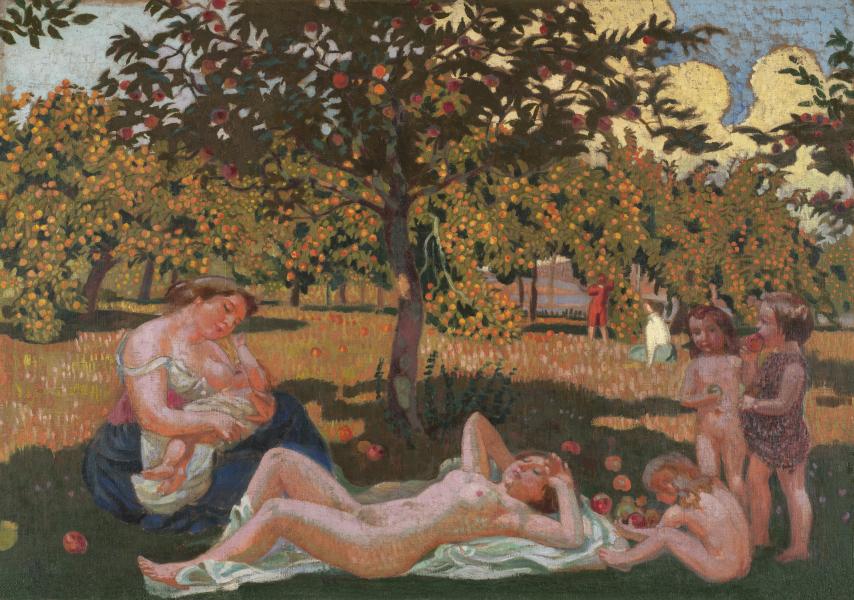
Bucolique d'Automne ou L'Heureux Verger, 1906
Oil on canvas, signed and dated lower left.
82 x 117 cm
Provenance:
• Baron Eberhard von Bodenhausen, acquired from the artist in 1906
• Bernheim-Jeune, acquired from the above in 1908
• Miss Edwards, acquired from Bernheim-Jeune in 1919
• Galerie Philippe Reichenbach, Paris
• Collection of Walter P. Chrysler Jr., New York (in his collection by 1960)
• Collection of Stuart Pivar, New York, until 2021
• Private collection, Switzerland
Exhibitions :
• Salon de la Société nationale des Beaux-Arts, Grand Palais, Paris, 15 April – 30 June 1906, no. 389, reproduced in the catalogue in black and white, p. 19.
• Fifteenth Exhibition of the Berlin Secession, Berlin, Spring 1908, no. 46.
• Internationale Kunstschau, Secession Building, Vienna, May – October 1909, no. 15, room 18, reproduced in the catalogue.
• Nus, Galerie Bernheim-Jeune, Paris, 17–28 May 1910, no. 30.
• Exhibition of French Art of the 18th, 19th and 20th Centuries, Leipziger Kunstverein, Leipzig, October – November 1910, no. 55.
• International Art Exhibition of the Munich Secession, Royal Exhibition Building at Königsplatz, Munich, 16 May – 31 October 1911, no. 36.
• Exposition d’Art contemporain, Galerie Manzi-Joyant, Paris, 12–31 October 1912, no. 44.
• Exhibition of French Art, Zurich Kunsthaus, Zurich, 16 February – 26 March 1913, no. 93.
• Great French Masters of the 19th Century, Ernst Museum, Budapest, September 1913, no. 78.
• Le Paysage du Midi, Galerie Bernheim-Jeune, Paris, 8–16 June 1914, no. 26. • Exhibition of Painting, Series C, Galerie Bernheim-Jeune, Paris, 19–30 June 1916, no. 13.
• French Paintings 1789–1929 from the Collection of Walter P. Chrysler Jr., Dayton Art Institute, Dayton, 25 March – 22 May 1960, no. 94, ill.p. 102.
Certificate of inclusion in the artist’s catalogue raisonné issued by Claire Denis and Fabienne Stahl.
When Maurice Denis painted this work in 1906, he had already acquired a certain reputation as an avant-garde artist. He had distinguished himself among the Nabis and had defended resolutely modern ideas in the press:
“Remember that a painting—before being a battle horse, a nude woman, or some anecdote—is essentially a flat surface covered with colours assembled in a certain order.”
As early as the summer of 1890, in the journal Art et Critique, he set out his celebrated definition of “neo-traditionalism.” Modern, certainly—but Denis did not envisage the modernity he defended at any price.
This painting, L'Heureux Verger, fully illustrates the scope of the artist’s theories. In this fertile orchard, childhood flourishes alongside Woman. The nudity is not intended to be erotic but virginal or nurturing, imbued with an immobile gentleness. At the centre of the composition, a generous fruit tree offers its shade and its apples without reserve. The mother becomes the natural extension of the trees bearing their fruit. No male figure comes to disturb this Arcadian harmony. Eve has redeemed her fault—or perhaps she never committed it.
Maurice Denis had not yet fully embraced the religious rhetoric to which he would later devote himself; nevertheless, it already clearly emerges in a work of such scope.
The painting does not aspire to copy Nature: it conveys its idea—or one might say here, the Ideal. At the end of this garden, where time seems to have suspended its course, a glimpse of the sea reminds us that the painting was conceived during a stay by the artist at Le Pouldu, on the Breton coast. If Henri Matisse, Paul Signac, or Henri-Edmond Cross found in the South the stage for their Edenic symphonies, when Maurice Denis withdrew from the agitation of the capital to seek inspiration, he remained faithful to the Breton shoreline—more frequently visited by the Nabis, who had made it the laboratory of their pictorial experiments.
Thus, at the dawn of the twentieth century, the South was not the sole support for Arcadian inspiration among painters. Brittany, too, possessed a preserved natural environment capable of crystallising the ideals of an entire generation of artists, who set out—sometimes combining political commitment with that of the brush—in pursuit of a lost golden age. Far from seeing this peaceful quest fulfilled, the Great War would soon overtake them, brutally closing more than one artistic chapter of this fertile early century.